
$27.00 
Learn more

If you invest in cryptocurrency or digital assets, you may receive a new tax form in your mailbox, inbox, or available for download: Form 1099-DA (Digital Asset Proceeds From Broker Transactions).
For many taxpayers, the arrival of a new tax form creates immediate anxiety: Does the IRS think I did something wrong? Am I going to owe a massive tax bill? Why have I never seen this form before?
The good news is that Form 1099-DA is primarily an informational reporting tool. Understanding what it reports—and what it leaves out—will help you avoid costly filing errors and keep your return fully compliant.
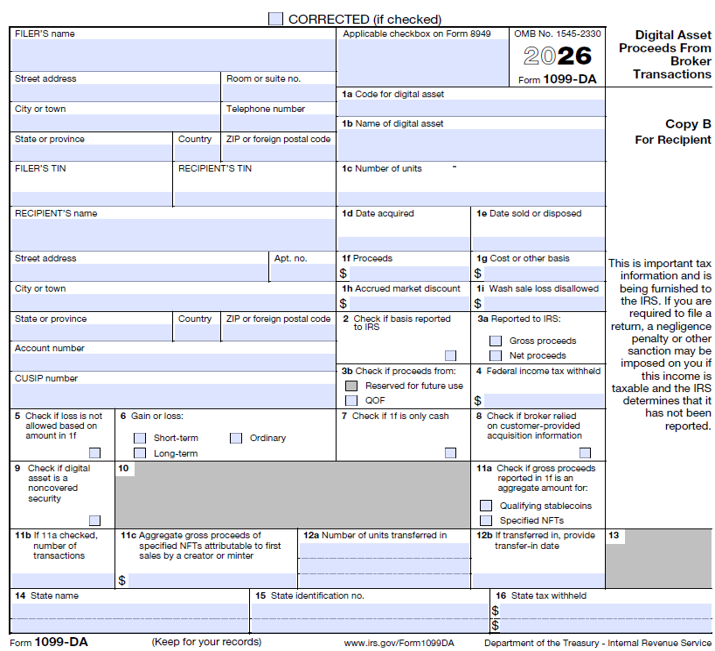
What Is Form 1099-DA?
Digital assets include cryptocurrencies such as Bitcoin and Ethereum, stablecoins (assets designed to track a fiat currency like the U.S. dollar), and non-fungible tokens (NFTs).
For years, digital asset tax reporting was inconsistent across platforms. Some exchanges issued Form 1099-MISC, others sent Form 1099-K, and many provided no tax forms at all. Form 1099-DA was created by the IRS to establish standardized, centralized reporting for digital asset transactions across all U.S. brokers and exchanges.
It’s an Informational Return, Not a Tax Bill
One of the most important things to remember is that Form 1099-DA is not a tax bill. It is simply an informational return sent to both you and the IRS detailing your transaction activity.
Example: Proceeds vs. Taxable Gain
Suppose you purchased Bitcoin for $15,000 and later sold it for $25,000 in cash—or traded it for $25,000 worth of Ethereum. Your Form 1099-DA will report gross proceeds of $25,000 (Box 1f). However, your taxable capital gain is only $10,000 ($25,000 proceeds minus your $15,000 cost basis).
Important Reminder: Cashing out to U.S. dollars isn’t the only trigger for a Form 1099-DA. Exchanging one cryptocurrency for another, trading for an NFT, or using crypto to purchase goods or pay network gas fees are all reportable dispositions that generate a Form 1099-DA.
Understanding the Phased Rollout (2025 vs. 2026 Rules)
Under Treasury regulations, broker reporting for Form 1099-DA is phasing in over two stages:
If Box 1g is blank on your form, you are still legally required to calculate and report your original cost basis on your tax return.
The Wallet Transfer Challenge
Many taxpayers move assets between centralized exchanges and self-custody wallets. Think of a digital wallet as a tool that allows you to store and control your cryptocurrency.
If you purchased Bitcoin on Exchange A, transferred it to a private wallet, and later moved it to Exchange B to sell, Exchange B may not know what you originally paid for it on Exchange A.
Form 1099-DA accounts for this dynamic:
COMMON MISCONCEPTION
“My Form 1099-DA shows $25,000 in Box 1f, so I must owe tax on $25,000.”
Not necessarily. The form reports what you received from the sale or trade (gross proceeds). Taxpayers must subtract their original cost basis (what they paid plus allowable transaction fees) to calculate their actual capital gain or loss before figuring any tax owed.
TAX TIP: What About Staking, Mining, and Airdrops?
Form 1099-DA is strictly used to report capital asset sales, trades, and dispositions. Income earned from staking rewards, mining, or airdrops is classified as ordinary income upon receipt. These earnings are reported on Schedule 1 or Schedule C and will not appear on Form 1099-DA. If a platform reports staking or mining income, they may issue a Form 1099-MISC or Form 1099-NEC instead.
How Form 1099-DA Fits On Your Tax Return
The data from your Form 1099-DA flows directly onto Form 8949 (Sales and Other Dispositions of Capital Assets) and Schedule D:
Three Steps to Take Now
The Bottom Line
Receiving a Form 1099-DA does not automatically mean you owe additional tax. It simply means that IRS matching systems now have direct visibility into your digital asset transaction proceeds. Maintaining detailed records and understanding how gross proceeds translate into taxable capital gains will help you file an accurate return with total confidence.
About the Author
Tynisa “Ty” Gaines, EA has more than 20 years of experience in the tax profession and is a nationally recognized tax educator, author, and speaker. She is a former President of the Virginia Society of Enrolled Agents, former Director of the National Association of Enrolled Agents, and former Editor-in-Chief of the EA Journal. She received the NAEA Mentor of the Year Award in 2022 and the NAEA Excellence in Education Award in 2025.
Ty is the author of Tax-ish and Tax-ish 2.0, contributes to J.K. Lasser publications, teaches EA exam preparation at Molloy University, and serves as a Tax Project Manager with TokenTax LLC specializing in digital asset taxation and compliance. She is known for translating complex tax concepts into practical guidance for taxpayers and tax professionals alike.
Interest on debt used to carry investments, but not including interest expense from a passive activity. Deductions are limited to net investment income.
Copyright © 2000- John Wiley & Sons, Inc., or related companies. All rights reserved. Please read our Privacy Policy.