
$27.00 
Learn more

One of the most common statements I hear from cryptocurrency and digital asset investors is:
“I never cashed out to my bank account, so I don’t have to report anything to the IRS.”
Unfortunately, that is one of the biggest—and most costly—misconceptions in tax planning.
Many digital asset transactions trigger taxable events even when not a single dollar is transferred to your traditional bank account. Understanding how the IRS views non-cash transactions is one of the most critical steps you can take to avoid unexpected tax bills and penalties.
Cash Sales vs. Non-Cash Dispositions
Selling cryptocurrency for U.S. dollars is the most obvious taxable event: if you buy a digital asset for $1,000 and sell it for $2,500, you have a $1,500 taxable capital gain.
However, under Internal Revenue Code Section 1001, taxable dispositions are not limited to cash sales. The IRS treats digital assets as property, meaning any exchange of one property for another realizes a gain or loss.
.
Example: Exchanging One Crypto for Another
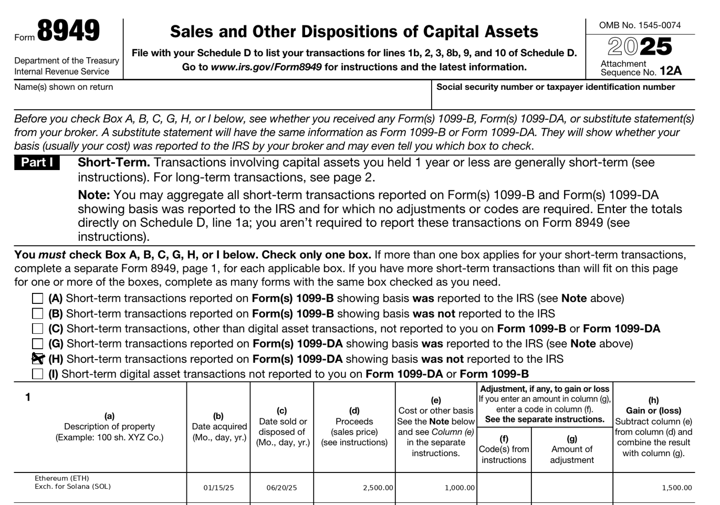
Suppose you purchased Ethereum (ETH) for $1,000. Several months later, when your ETH is worth $2,500, you exchange it directly for Solana (SOL).
Even though no U.S. dollars touched your bank account, you disposed of your Ethereum. You must report a $1,500 capital gain ($2,500 fair market value of SOL received minus your $1,000 ETH cost basis) on Form 8949.
How a Crypto Swap Appears on Your Tax Return
To see how this works in practice, look at the sample Form 8949 (Sales and Other Dispositions of Capital Assets) below:
Notice that:
What About Stablecoins?
Investors often assume exchanging volatile crypto for a stablecoin (like USDC or USDT) is non-taxable because stablecoins are pegged to $1.00.
However, the tax event isn’t triggered by the stablecoin gaining value—it is triggered because you disposed of the appreciated cryptocurrency to buy the stablecoin. Moving from Bitcoin into a stablecoin to “lock in profits” realizes those profits for tax purposes at the exact moment of the trade.
What About NFTs?
NFTs (non-fungible tokens) are unique digital assets. Tax consequences occur in two ways:
Don’t Forget the Form 1040 “Digital Assets” Question
Regardless of whether you owed tax, the IRS requires almost every taxpayer to answer the Digital Assets question near the top of Form 1040:
“At any time during the tax year, did you: (a) receive (as a reward, award or payment for property or services); or (b) sell, exchange, gift or otherwise dispose of a digital asset (or a financial interest in a digital asset)?”
If you swapped ETH for SOL, bought an NFT, or traded for a stablecoin, you must check “Yes” under penalties of perjury.
Non-Taxable Digital Asset Activities
To keep things in perspective, the following actions do not trigger a taxable event:
COMMON MISCONCEPTION
“Taxes only apply when money reaches my bank account.”
False. Tax law focuses on whether ownership of an asset changed, not whether cash was withdrawn to a traditional bank. Every exchange of digital property is a realization event.
The Bottom Line
Cashing out to fiat currency is only one type of reportable transaction. Crypto-to-crypto swaps, stablecoin trades, NFT purchases, and decentralized finance (DeFi) interactions can all generate reportable gains or losses.
Reviewing your complete transaction history across all platforms—and reading [Part 1: Your First Form 1099-DA: What Crypto Investors Need to Know]—will ensure you file an accurate return without any surprises.
About the Author
Tynisa “Ty” Gaines, EA has more than 20 years of experience in the tax profession and is a nationally recognized tax educator, author, and speaker. She is a former President of the Virginia Society of Enrolled Agents, former Director of the National Association of Enrolled Agents, and former Editor-in-Chief of the EA Journal. She received the NAEA Mentor of the Year Award in 2022 and the NAEA Excellence in Education Award in 2025.
Ty is the author of Tax-ish and Tax-ish 2.0, contributes to J.K. Lasser publications, teaches EA exam preparation at Molloy University, and serves as a Tax Project Manager with TokenTax LLC specializing in digital asset taxation and compliance. She is known for translating complex tax concepts into practical guidance for taxpayers and tax professionals alike.
A filing status entitling the taxpayer with dependents to use joint tax rates for up to two tax years after the death of a spouse.
Copyright © 2000- John Wiley & Sons, Inc., or related companies. All rights reserved. Please read our Privacy Policy.